
Of the few pesky ailments I’ve struggled with in my life, chronic neck pain was one of the absolute worst. Obviously it was physically debilitating, but it was also a great source of mental anguish. I was already fighting losing battles with gut issues and dissociative anxiety as documented in other writings on this site, and the constant pain in my neck and shoulders, as well as the headaches and visual issues, were the icing on my cake of misery. Fortunately after several miserable years, I got a much needed win – I fixed my neck pain in a relatively short period of time. Though my other issues have been more enduring, I can proudly say that as long as I stay diligent with my protocol, neck pain doesn’t bother me anymore. In fact I fixed this problem years ago, and wrote about it back then on my old site (which I accidentally corrupted the URL on). The article generated nearly a thousand views in a short time which was a big deal for me at the time, but also showed that there are plenty of people who might benefit from my experience – hence the decision to revisit the topic.
A lot of the misery of my neck pain was rooted in frustration – I was doing everything right I supposed. I practiced good form in my training, and had worked hard at fixing my posture after the video-game playing posture of my youth (and the shoulder problems that posture led to..).

Most frustrating of all, I followed the advice of the physiotherapists (and osteopaths) I had seen, all of whom blamed my ‘overactive’ upper traps and prescribed voluminous neck stretching. Now this isn’t a physio bashing article, but it is a reminder that professionals are still just as fallible as every other human being. And in this case every one that I saw got it completely wrong and actually exacerbated my chronic neck pain. Most of the damage was done with three key pieces of bad advice:
- To deactivate my overactive traps
- To stretch the sore and tight areas
- The ‘shoulders back and down’ postural cue
It wouldn’t make sense for me to trash talk therapists just because of the bad advice I received, because it was another therapist who ultimately proved to be the catalyst for my recovery. After enduring the pain and misery of failed rehabilitation for a couple of years I finally decided to try seeing someone again. Immediately he showed promise with a different approach after hearing my neck pain background. He advocated some neck strengthening exercises instead of arbitrary stretching. But the biggest turning point was when he noted that though my upper traps did appear disproportionately big, they didn’t actually seem to be functioning remotely well in their job of facilitating upwards rotation of the scapula during overhead arm movement. The suggestion that my traps were actually dysfunctional as opposed to overactive was so contrary to what I’d previously heard that it sent me down a researching rabbit hole. It was in this research that I finally, after years of misery, came upon the true cause of my neck pain – a postural defect that I have rarely ever seen discussed known as depressed shoulders.
Essentially if you roll your shoulders ‘back and down’ (supposedly for good posture) you are depressing your shoulders. If you do this too much, or have a natural tendency toward sloping shoulders, or work at a low desk too much, or for some other reason – you can wind up with shoulders that are constantly depressed. This is bad because your upper traps, levator scapulae and posterior neck muscles are in a permanently stretched state which will cause atrophy, dysfunction and imbalances. The tension of being in this perpetually lengthened state and the weakening of the affected muscles that it causes, can manifest itself as a feeling of tightness and pain that we know well. If you then proceed to stretch your neck and traps to address the ‘tightness’ when you have depressed shoulders, you are just compounding the problem.
Why do we stretch? Stretching is often presented as a cure-all for any muscular ailment, but it’s best utilised on a case-by-case basis. If you have a legitimate mobility/flexibility issue then it obviously makes sense to work to increase your range of motion. Or if you have an issue such as forward shoulder posture then you would want to stretch your chest because your pecs are in a chronically shortened position. But conversely you wouldn’t want to stretch your mid-back (rhomboids, mid traps, scapula, etc) which is already being stretched in the forward shoulder position. Those are the muscles that must be strengthened. If we apply that same logic to the depressed shoulder posture, we can see that the lats might benefit from a good stretch (if they are tight, they will be contributed to the postural dysfunction and pulling the scapula down), but what is most fundamental is strengthening the upper traps, levator scapulae and posterior neck muscles, and working toward maintaining a new shoulder posture. Once I implemented this approach my neck pain began to fade rapidly and as long as I have remained diligent, it has stayed away.
The protocol:
Nowadays the rationale behind my method for maintaining neck health is simple: if I practice good posture, maintain neck and shoulder strength and my scapula is functioning optimally – why would I ever get neck pain? – The answer is I don’t. Following on from that rationale, and reflecting on my own rehab routine, this is what I would recommend:
Determine if you have depressed shoulders
So how do you know if you have depressed shoulders? Have a look at your shoulders. Do they look depressed? Do they seem to slope downward? Perhaps you’ve had comments from therapists before who couldn’t quite connect the dots about the appearance of your upper traps. I used to hear that I had ‘disproportionately big upper traps.’ This led to the misdiagnosis that my traps were ‘overactive.’ In actual fact they just appeared enlarged because of the enhanced slope of my shoulders from my poor shoulder posture. It should be quite easy to tell, but if you’re still in doubt then just trace the angle of your collarbone from the base of your neck to your shoulder joint. Ideally your collarbone would slope slightly upwards toward your shoulder. If it’s more of a straight line then you’d likely benefit from some work on them, if it’s sloping downward then you’ve got a problem with your shoulder depression. If that is the case and you’re also sporting neck pain, I think you can confident that you’ve found the culprit of potentially the entirety of your chronic neck pain. I for one, no longer have any issues, which I probably don’t appreciate the magnitude of enough. Considering once you’re no longer in chronic pain, you quickly forget how bad life used to be. But for nearly 3 years I had constant pain as my companion. As well as headaches, and symptoms of thoracic outlet syndrome.
Ever since learning about my own depressed shoulders and healing my chronic neck pain, I notice depressed shoulders on people everywhere. It’s part of the reason I’ve felt compelled to write this article, because I see these people and want to go up and ask them if they have chronic neck issues. But I don’t of course.

Embrace your new shoulder posture
This means instead of maintaining depressed shoulders as your resting shoulder posture, you need to get in the habit of a neutral/slightly elevated shoulder position. A slight upwards angle of the collarbone toward the shoulder joint is ideal. I’ll bet it feels uncomfortable. You might wonder how you could possibly maintain this new posture all the time. You won’t be able to. You will constantly fall back into old, depressed ways, and that’s just part of the experience. You will have been creating this dysfunction for years and as such the bad postural habits are deeply ingrained. No matter how vigilant you might be in keeping the shoulders out of depression, it is uncomfortable and unsustainable in the short-term. Your shoulder and neck muscles are likely so weak from being chronically lengthened, that they simply lack the muscular endurance to maintain the new posture consistently.
Strapping can help
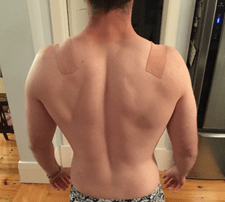
One thing you can do to assist with the difficulty of keeping your shoulders out of depression, is strap your shoulders to support the new posture. You will need a willing participant to do it for you. Most importantly make sure the strapping is applied whilst your shoulders are in the position you would like the strapping to support. A good tip is to put your hands on your head and then take your hands back down whilst maintaining the natural shrug of your shoulders that occurs when putting your hands on your head. The strapping will not only help to keep the shoulders in said position, but when your good posture inevitably slackens you will feel the tape ‘pull’ and you can correct your posture. So, it is both supportive and a warning system.
Consider adjusting your lifestyle + training routine as you first address your depressed shoulders
During the initial stages of rehab from the pain of depressed shoulders it is prudent to make some lifestyle modifications to address the ways in which you might be exacerbating the dysfunction. For example I stopped all exercises at the gym that involved shoulder depression – this meant no deadlifts, no pull-ups/lat pull-downs, tricep extensions or heavy carries. I stooped for a couples of weeks and used the time to focus a lot on training my shoulders and scapula upwards rotation. I was so intent on fixing the problem that I even stopped walking to the supermarket and drove instead so that I wouldn’t have to carry heavy bags by my side all the way home (big shoulder depression). Anytime that I was lounging around on the couch I had a couple of cushions on standby to place under my arms for support. It is incredibly relaxing to sit like this if you have been suffering from depressed shoulders. Really gives those aggravated muscles a much need opportunity to rest and relax.
A rehabilitation program that strengthens, not stretches, the affected muscles
In combating depressed shoulders we absolutely want to strengthen the upper traps and levator scapulae, the posterior neck muscles, and our upwards rotation/small muscles of the scapula.
Here is the exact routine that I did (and still incorporate into my training) in accompaniment to the aforementioned lifestyle + postural modifications that defeated years of crippling neck pain:
Shrugs
– Pick your favourite shrug variation (dumbbell shrug, barbell shrug, monkey shrug or even reverse shrugs). I personally prefer wide grip barbell shrugs because the extra abduction of the arms engages the levator scapulae more as there is some rotation of the scapula involved.
– Do 1-2 sets of a weight that you can perform 15 slow, quality reps with, the last few reps should be challenging, but not max efforts on the verge of failure.
Wall angels

Now that we’ve got our shoulders nice and shrugged and the traps warm, it’s time for what is a deceptively challenging exercise. Start in the a position and press slightly back into the wall with your arms as you raise them overhead in a shoulder pressing motion, keeping contact between your wrists and the wall. Then maintaining the same resistance + contact return to the starting position. Forgot about high numbers with this exercise. I’d recommend just focusing on mastering 2 sets of 5 really good (+ slow) reps before you start working toward higher volumes. This exercise is going to do wonders for retraining your scapula to function optimally when facilitating overhead movements, and fires up all the little muscles of your back and scapula while doing so.
Neck Extension
Lie down off the edge of a bed or bench with your head over the side. Start with your chin at your chest and then extend your head backwards as if you were trying to look at the ceiling, stop when you feel the contraction in your posterior neck muscles, and repeat. In my experience this will be quite difficult at first, as the neck is likely very weak. You can start on the floor at first with a shorter range of motion, or even just begin seated in a chair practicing looking up at the ceiling (make sure your shoulders aren’t in a depressed position when performing this exercise). Building up to 1 set of 15-20 reps without added weight should be sufficient for building necessary neck strength in my opinion.
Go gently with your rehab.
Performing the routine every few days is sufficient at first. It is intentionally low on volume, and you should be wary of adding more. The first few times I strengthened these long dormant muscles, combined with constant vigilance toward my new posture, meant that my neck initially got sorer before it got better. It is a different kind of soreness though, the pain of progress (hopefully) – always listen to your body and remember I am not a medical professional of any kind. Just some schmuck on the internet who used to suffer daily with chronic neck pain documenting what worked for me.
I hope this article can provide some hope and potentially even some relief to any sufferers of chronic neck pain out there.
Cheers
Remy.
 Toomanymind